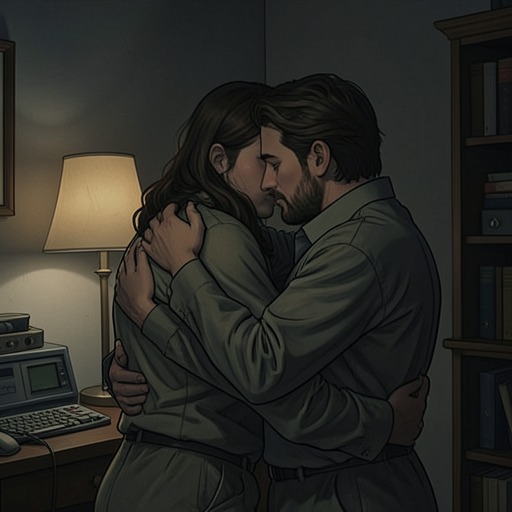
Hardin rushes to Seattle to find Tessa drunk
After Ever HappyHardin’s journey to Seattle to find Tessa drunk turns an anxious phone call into a physical crossing of distance: he leaves as soon as he hears how distressed she sounds, then searches until he finds her alone on a patio. The episode exposes the care and fear beneath his repeated pursuit, while his recognition of their destructive cycle makes the drive feel like both another return and a promised turning point.
The call and its warning signs
Tessa tells Hardin she is fine and jokes that she is allowed to drink, calling him “Dad.” The joke does not reassure him: the way she says the last word chills him, and she sounds sad enough that he gets to his feet. He knows he is hardly in a position to lecture her. He believes he helped make her drinking regular, but now the thought of her drinking alone fills him with mounting paranoia.
When Tessa says she is not drinking too much, she shifts to a broader sadness: “It’s weird how someone can be a good person but bad things just keep happening to them. You know?” Hardin answers that he understands and agrees it is unfair. His response turns the moment inward as well as toward her: he thinks of Tessa as the best person he has known and himself as the worst among the people who have surrounded her with trouble. Her distress is not presented as a simple question of how much wine she has had; the conversation makes clear that she is drinking while feeling that life has treated her unjustly.
Hardin urges her to stop for the night and tells her he is coming to Seattle. He acknowledges that she needs space, but says he is worried and cannot stay away. Tessa is barely listening. When he asks her to get water, she agrees in a slurred, distracted way. The call gives him enough to act on, but not enough to settle his fears about what will happen before he reaches her.
The drive and the cycle he recognizes
Hardin grabs his keys and pushes on his Vans rather than lose time putting on boots. Seattle feels impossibly far away. He texts Vance again, telling him to get home immediately, then continues toward Tessa. The urgent trip is thus not simply a private attempt to reach her: Hardin also tries to bring another person into the response, even as the distance leaves him feeling that he must go himself.
On the drive, Hardin sees the pattern that Tessa has repeatedly complained about. He understands his departure from her and his journeys back toward her as a cycle: he runs from his problems, then crosses Washington to regain closeness. He declares that this will be the last time he drives to another city for that purpose, and resolves to stop making excuses. The vow gives the journey a double meaning. It is one more act of returning, but he wants it to mark the end of the behavior that keeps making return necessary.
Searching for Tessa
At the mansion, Hardin has called forty-nine times. He searches nearly the entire house, struggling to breathe as the remaining possibilities narrow to Vance’s bedroom and a locked room upstairs. He considers the locked room but is uncertain whether he wants to open it. Rather than find Tessa there, he checks the patio and yard, with no clear idea what he will do if she is not outside.
He calls out for “Theresa” and stops when he sees her curled into a ball on a patio lounge chair. Her knees are drawn to her stomach and her arms wrap around her chest, as if she fell asleep trying to hold herself together. The sight dissolves his anger. Kneeling beside her, he moves her blond hair from her face and struggles not to break down now that he knows she is alive and safe in that moment. His frantic search has been driven by fear; seeing her changes its immediate force into relief.
Finding her and beginning to listen
As Tessa stirs and tries to stand, an empty wine bottle falls onto the concrete patio and breaks in half. She apologizes and bends to pick up the glass. Hardin gently stops her hand, takes hers, and says, “Don’t touch that. I’ll get it later. Let’s get inside.” At least four more empty bottles are visible in the kitchen, so the broken bottle is not the only sign of how much she has been drinking. Hardin helps her up rather than turning the moment into a reprimand.
Tessa asks how he got there; he answers that he drove. When she snaps at him not to scold her, he raises his hands to show that he is not doing so. He is painfully aware of the irony: she is drunk, while he has become the sober voice of reason. The reversal does not erase his responsibility, which he has already connected to her regular drinking, but it shapes how he handles her now. He avoids arguing over her accusation and stays with the practical need to get her safely inside.
Tessa then apologizes, says she cannot think, lowers herself to the ground, and draws her knees to her chest again. Looking up at Hardin, she asks whether she can talk to him and whether he will be completely honest. The scene ends at the threshold of that conversation. Hardin has found her and prevented her from handling broken glass, but the larger problem that brought him across the state remains to be spoken about.
Significance
The action holds together two competing versions of Hardin’s return. His haste, repeated calls, and search show how deeply he fears losing track of Tessa; his own account of the long drive also identifies pursuit and flight as parts of a relationship cycle he wants to stop. His promise not to make another such drive is therefore an intention, not proof that the cycle has already ended. The scene lets concern and accountability sit beside each other without resolving the tension between them.
Tessa’s request for an honest conversation shifts the episode away from rescue as a complete solution. Hardin can reach Seattle, find her, and keep her from the broken bottle; he cannot answer the emotional question she is preparing to ask by performing those actions alone. The closing request makes listening the next test of his presence. The drive brings him to her, but what follows depends on the honesty she explicitly asks for.